Yamaha TRBX505 Review: Is This Active 5-String Worth It?
I’ll be upfront with you before we go any further — I’m a BB guy. Always have been. The passive tone, the vintage feel, the way it sits in a mix without you having to think about it. That’s my world. So when I tell you the TRBX505 is worth your attention, understand it’s coming from someone who doesn’t particularly need active electronics in his life. But a lot of my students do. And this bass delivers for them in a way that’s hard to argue with. Over 59,000 people have watched my demo of this thing — so clearly I’m not the only one curious about it.
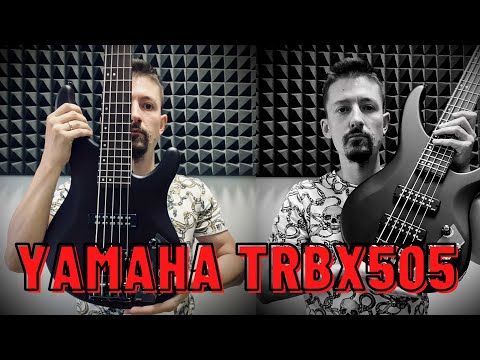
The TRBX505 is a five-string active bass that Yamaha lists at $679.99. Solid mahogany body, 34″ scale, 3-band active EQ with an active/passive switch, two Alnico humbuckers. Light, balanced, comfortable to play for long periods. That last part matters more than the spec sheet suggests — if a bass is uncomfortable after an hour, you stop playing it. Simple as that. The 505 doesn’t have that problem. It’s one of those instruments you put on and forget you’re wearing.
The scale is a standard 34″, the same as most competitors at this price, so the 505 doesn’t get its low B from extra string length. Five-string basses with a budget price tag often have a floppy, useless low B — the string has no tension, it sounds undefined, and you end up avoiding it. On the 505 the B string is actually usable. Not world-class tight, but workable enough to play in a real band situation without embarrassing yourself. For the price, that’s a big deal.
Rating: 5/5
Verdict: The Yamaha TRBX505 is an active 5-string with a solid mahogany body, a standard 34″ scale, a 3-band EQ with an active/passive switch and a usable low B. Its preamp shapes tone without sounding artificial, and the bass is light and comfortable for long sessions. It is ideal for players of modern styles who need five strings and active tone shaping. It is not for vintage-tone players or anyone who just wants a passive four-string.
| Spec | Yamaha TRBX505 |
|---|---|
| Scale | 34″ (863.6 mm) |
| Body | Solid mahogany, sculpted; satin polyurethane |
| Neck / fretboard | Maple/mahogany 5-piece, bolt-on; rosewood fretboard, 24 frets, 43 mm nut |
| Pickups | 2 YGD-designed H5 humbuckers, Alnico V |
| Electronics | Active with passive switch; battery alert LED |
| Controls | Master volume, pickup balancer, 3-band EQ (bass, middle, treble), active/passive switch |
| Bridge | Die-cast; 18 mm string spacing |
| Strings | D’Addario EXL170-5 (.045–.130) |
| Best for | players of modern styles (gospel, funk, pop, worship) who need five strings and active tone shaping; students who gig regularly |
| Not for | primarily vintage-tone players and anyone who just wants a great passive four-string (he points to the BB434) |
Free: Slap Bass Starter Pack
5 video lessons with slow-motion takes, drum loops and tabs. Enter your email and download it right away.
The Active EQ: This Is Where It Gets Interesting
Here’s my honest relationship with active basses — I tolerate them when the preamp is good and avoid them when it isn’t. Most budget active basses have preamps that colour the tone in a way that sounds artificial. You boost the bass and it goes boomy instead of warm. You cut the mids and it sounds scooped instead of focused. The TRBX505 preamp is actually decent. It doesn’t do anything weird. Bass boost thickens without getting muddy, mid cut gives you that modern scooped sound if that’s your thing, treble boost adds definition for slap without getting harsh.
I still prefer the passive sound of a BB434 for most of what I do — recording, session work, live playing where I know the room. But I understand why players who grew up on active basses feel at home with the 505. It gives you control. You can shape your sound without touching the amp. In a live situation where you’re moving between venues with different stage monitors and different FOH setups every night, that flexibility has real value. I’ve recommended this bass to students who gig regularly and every single one of them is happy with it.
TRBX505 vs BB434: Honest Comparison
People ask me this constantly, so here it is straight. The BB434 wins on tone character, warmth, and that intangible “feel” of a great passive bass. It has more personality. The TRBX505 wins on versatility, the five-string option, and active control. If you’re a four-string fingerstyle player who wants a bass with soul — go BB. If you play modern music, need five strings, or want to dial in your sound quickly on different stages — the 505 makes more sense.
The neck profiles are different too. The TRBX505 has a slimmer, faster neck — better for players who come from guitar or who play a lot of fast passages and slap. The BB series has a chunkier, more traditional feel that suits heavy fingerstyle playing. Neither is wrong. They’re just different tools for different hands. I know players who own both and switch depending on the gig. That’s probably the smartest approach if budget allows.
String spacing on the 505 is 18 mm at the bridge, the same as Yamaha’s BB435 five-string and a little tighter than the 19 mm on the four-string BB434. Coming from a four-string, the tighter spacing and the wider neck both take some getting used to, and slap on a five-string is notoriously awkward until you adapt. Players with bigger hands sometimes feel cramped. Try before you buy if you can.
Who Should Buy the TRBX505
If you play modern styles — R&B, gospel, funk, pop, worship music — and you need five strings with active tone shaping, this is probably the best value you’ll find under $700. Not because it’s perfect, but because nothing else at this price does all of those things as well simultaneously. The build quality is solid, nothing feels cheap, and Yamaha’s quality control at this price point is consistently better than most competitors.
I wouldn’t recommend it to someone who’s primarily a vintage tone player, or someone who just wants a great passive four-string. For that, save yourself some money and get a BB434. But if you know you need active electronics and five strings and you don’t want to spend a thousand dollars to get them — the TRBX505 earns its place. It’s a serious instrument made for players who are serious about what they do. I just happen to personally prefer the sound of wood doing its thing without a battery involved. Doesn’t mean I can’t recognize a good bass when I play one.
Questions about the 505 or how it compares to something else you’re looking at — drop them below. I’ve played almost everything in this price range and I’ll give you a straight answer.
Frequently Asked Questions
Is the Yamaha TRBX505 good for beginners?
It’s playable for beginners but better suited for intermediate players who know they need active electronics and five strings. If you’re just starting out, the Yamaha BB235 is a simpler, cheaper first five-string.
What scale length is the TRBX505 and why does it matter?
The TRBX505 has a standard 34″ scale, not an extended 35″ one like Yamaha’s TRB1005J. Scale length affects string tension, especially on the low B, so the 505’s B string has normal 34″ tension. It’s still usable in a band context, but don’t expect the extra tightness of a 35″ five-string.
TRBX505 vs Yamaha BB435 — which should I buy?
If you want passive, warm, vintage-leaning tone — go BB435. If you want active EQ control, a faster neck, and a more modern sound — TRBX505. I cover both basses in detail in my Yamaha BB series guide.
Does the TRBX505 need batteries?
Yes — it runs on a 9V battery for the active preamp. The battery compartment is on the back with a simple cover, no screws. Easy to swap mid-gig if needed. Expect 6-12 months of regular playing from one battery.
Is the low B string on the TRBX505 usable?
Yes. Even on a standard 34″ scale, the low B is tighter and more defined than on most basses at this price. Not as tight as a Dingwall or a high-end Ibanez, but completely usable in live and recording situations.
Related reads: Yamaha BB Series Guide · Yamaha BB235 Review · BB435 vs TRBX305 Comparison
Want to Level Up Your Bass Playing?
I’ve put together courses and resources that cover everything from slap fundamentals to advanced groove techniques.