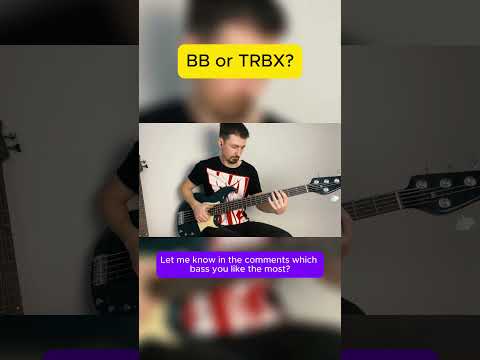
If you’re stuck between the BB435 and the TRBX305, you’re not choosing between a good bass and a bad one—you’re choosing between two completely different instruments that sit in a similar price range.
Verdict: The Yamaha BB435 and TRBX305 sit in a similar price range but are very different 5-strings. The passive BB435 has a warmer, traditional tone that sits in a band mix without EQ work. The active TRBX305 needs some shaping but covers different styles in one night and feels lighter on long gigs. The BB435 suits players who mostly play one style; the TRBX305 suits players who switch styles or play long sets.
Vintage Plus Light, convertible stringing; 18 mm string spacing
Die-cast; 18 mm string spacing
Strings
D’Addario EXL170-5 (.045–.130)
D’Addario EXL170-5 (.045–.130)
Best for
players who mostly play one style (rock, soul, funk) and want a bass that sits in a band mix without EQ work
players who cover several styles in one night and play long sets
Free: Slap Bass Starter Pack
5 video lessons with slow-motion takes, drum loops and tabs. Enter your email and download it right away.
Two basses, two different philosophies
I’ve played both of these extensively, and the question I get all the time is “which one should I get?” The honest answer depends entirely on what kind of player you are and what kind of stages you’re playing. The BB series has been around since the late 70s—it’s Yamaha’s take on the classic P/J formula, passive, punchy, traditional. The BB435 has a solid alder body, a 5-piece maple/mahogany neck, and pickups that just sit in a live mix without any tweaking. You plug it in and it sounds like a bass is supposed to sound. There’s a reason working musicians have been gigging these for decades.
The TRBX305 is a completely different animal. Active preamp, sculpted mahogany body, lighter overall, and a 5-position Performance EQ switch plus 2-band EQ that let you sculpt your sound for basically any situation. The BB435 has this natural authority in the low mids that fills a band mix without fighting for space—you don’t have to EQ it to death. The TRBX305 needs a bit of shaping to really wake up, but once you dial it in, it handles completely different styles in the same night. I’ve done slap for one set and fingerstyle for another on a TRBX305 and the onboard EQ handled all of it. It’s also noticeably lighter on the shoulder after a 3-hour gig, and that matters more than people admit.
Feature
BB435
TRBX305
Electronics
Passive
Active
Raw tone
Warmer, more organic
Needs shaping
Weight
Heavier
Lighter
Tonal flexibility
Limited
Performance EQ + 2-band EQ
Best for
Rock, soul, funk
Multiple styles, long gigs
If you mostly play one style and want a bass that sounds great without thinking about it—BB435. If you play across different styles or you’re doing long sets and your shoulder matters—TRBX305. Both are genuinely excellent instruments for the money. Which one are you leaning toward?
Frequently Asked Questions
Is the Yamaha BB435 better than the TRBX305 for beginners?
Depends on what you prioritize. The BB435 has a more traditional feel and a warmer tone — better for fingerstyle and groove playing. The TRBX305 has active electronics and a more modern sound. If you want versatility, go TRBX. If you want classic bass tone, go BB.
Which Yamaha 5-string bass is better for slap bass?
The TRBX305 handles slap better out of the box — the active preamp gives you more mid scoop and punch. The BB435 can slap well too, but its passive pickups have a rounder tone that works better for fingerstyle funk.
Is the low B string tight on budget 5-string basses?
It varies a lot. Both the BB435 and TRBX305 have acceptable B strings for the price range, but neither is as tight as a $1,000+ instrument. The key is proper setup — correct string height and intonation make a huge difference on budget basses.
People obsess over specs when buying a bass — wood type, pickup brand, hardware finish. After 25 years of playing I can tell you what actually matters on a five-string in this price range: low B tension, neck stability, and pickup output. Everything else is secondary. You can live with basic tuners. You can live with a simple bridge. You cannot live with a floppy B string or a neck that moves with humidity and throws your intonation off every week.
Both the BB435 and TRBX305 pass the fundamental tests. The low B on both instruments is usable — not world-class, but usable in a band context. Both necks are 5-piece maple/mahogany laminates, which helps stability. In my experience the TRBX305 neck feels a little more susceptible to seasonal movement. Not a dealbreaker, but worth knowing if you live somewhere with extreme humidity changes.
String spacing is where players often get tripped up, and here the two are identical: both have 18 mm spacing at the bridge, so any difference you feel comes from the rest of the instrument. Try both if you can. Your hands will tell you which one feels right within five minutes.
My Honest Recommendation After Playing Both
If I had to pick one for a student with a $500-700 budget who plays modern music and needs five strings — I’d probably lean BB435. The passive electronics are simpler, the tone is warmer and more versatile across different amp setups, and the build quality feels a half-step above the TRBX305. But the TRBX305 is not a bad bass. If you want active tone shaping and 24 frets instead of 21, it earns its price. Neither of these instruments will embarrass you on a gig. That’s the honest bottom line.
Whatever you choose — set it up properly. New strings, intonation checked, action adjusted to your playing style. A $300 bass with a proper setup plays better than a $700 bass that’s never been touched by a technician. This applies to every bass at every price point. Don’t skip the setup.
The BB435 sits in that sweet spot where a beginner can afford it and a working pro won’t be embarrassed by it. The neck profile on this bass is comfortable from day one — not too thick, not the kind of shredder-slim that makes fingerstyle exhausting after an hour. It’s a playing neck.
One thing I always tell students looking at this price range: don’t sleep on the passive electronics. Active pickups sound impressive at the music store because they’re loud and modern. But passive has dynamics. It responds to how hard you dig in. That relationship between you and the instrument is what builds real technique.
If you’re on the fence between the BB435 and TRBX305 specifically for gigging — take the BB. It sits better in a band mix without eq fights.
Want to Level Up Your Bass Playing?
I’ve put together courses and resources that cover everything from slap fundamentals to advanced groove techniques.