MXR Bass Overdrive M89 Review — Warm Grit That Cuts Through a Mix
Bass overdrive is a topic that splits players right down the middle. Half want something that sounds like a slightly cranked amp — warm, organic, responsive. The other half want something with character and grit that sits in a band mix without disappearing. The MXR Bass Overdrive M89 tries to be both.
I’ve been running this pedal in my signal chain for a while now and I have thoughts. Not all of them positive, but overall the M89 has earned its spot on my board in certain contexts.
Rating: 5/5
Verdict: The MXR M89 Bass Overdrive is a bass-specific, all-analog overdrive with Drive, Tone, Volume and a Clean blend control. It holds its low end together even at high drive, and its pushed mids cut through a live band mix. It suits rock, blues and soul players who want medium-gain grit without a manual. It is not for high-gain modern metal, maximum transparency or extensive tone shaping.
| Spec | MXR M89 Bass Overdrive |
|---|---|
| Type | Bass overdrive, 100% analog circuit designed for bass |
| Controls | Clean (blends in a tuned clean signal), Volume, Tone, Drive; footswitch with LED |
| Inputs / outputs | 1/4″ input, 1/4″ output |
| Impedance | Input 1 MΩ, output under 10 kΩ |
| Power | 9 V battery or 9 V DC adapter (Dunlop ECB003); 19 mA |
| Bypass | True bypass |
| Status | Legacy product, no longer in production |
| Best for | rock, blues, soul and R&B players who need presence in a live mix; players who want medium-gain grit that keeps the low end |
| Not for | high-gain modern metal or djent; maximum transparency; extensive tone shaping |
Free: Slap Bass Starter Pack
5 video lessons with slow-motion takes, drum loops and tabs. Enter your email and download it right away.
What the M89 Is Designed to Do
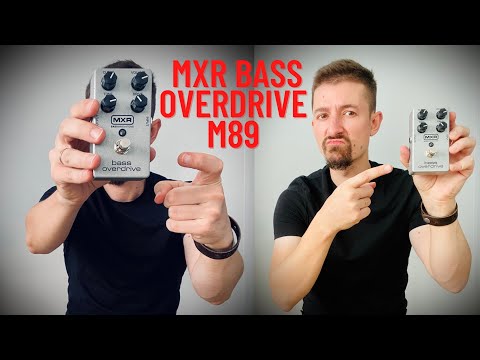
The M89 is a bass-specific overdrive — not a guitar overdrive with a bass blend knob bolted on, which is what a lot of “bass overdrive” pedals actually are. MXR built this one from the ground up for low frequencies. The circuit is designed to preserve low-end content while adding harmonic saturation to the midrange and upper frequencies.
The controls are simple: Drive, Tone, Volume and Clean. Four knobs. No EQ bands, no extra voicing switches. That simplicity is either a feature or a limitation depending on what you’re looking for.
The Clean knob is the one that matters most on bass: it blends a tuned clean signal back in with the overdrive, so you can keep a solid fundamental under the grit.
Tone Character — What It Actually Sounds Like
At low drive settings the M89 adds a gentle warmth and a slight compression that makes the bass feel more present in a mix. It’s not dramatic — you could argue it sounds like running through a good tube preamp rather than an overdrive pedal. That’s the sweet spot for players who want “something” without obviously sounding like they’re using a dirt pedal.
Push the drive past noon and the harmonic saturation becomes more pronounced. The mids get pushed forward, the attack gets slightly compressed, and you start to hear that gritty texture on note attacks. It’s controlled — never spiky or harsh. But it’s clearly overdrive territory now.
Full drive is where it gets aggressive. The low end holds together better than I expected — most overdrive pedals fall apart in the bottom end at high gain. The M89 maintains definition even when cranked, though at full drive the tone starts to feel slightly compressed and one-dimensional. Most useful settings are in the first two thirds of the drive control’s range.
The Tone knob is effective but sweeps a fairly narrow range. It does what it says but don’t expect massive tonal shaping from it. Think of it as a presence adjustment rather than a full EQ control.
How It Sits in a Band Mix
This is where the M89 either justifies itself or doesn’t. I’ve used it on stage and in studio sessions, and my honest assessment is: it works better live than in isolation.
Alone in a bedroom it can sound slightly compressed and midrange-heavy. That’s a characteristic of the circuit that becomes an advantage in a band context. Those pushed mids cut through guitars and keys without needing a separate boost. The low end stays thick enough to hold down the foundation. You remain audible and defined without having to fight for space in the frequency spectrum.
For rock, soul, R&B with edge — the M89 is a solid working-musician choice. It does its job without drama.
The Clean Control
There’s no noise gate on the M89. What it has instead is the Clean control, and that’s the more useful feature for a bass player.
Turn Clean clockwise and you blend in more of a preset-EQ clean signal; turn it counterclockwise and you hear more of the overdrive on its own. It’s a separate clean and drive balance in one knob, which is what most bass overdrives need and many guitar pedals don’t have.
Having that blend on the pedal itself, without needing a separate loop or blender, is the right design choice.
Compared to Other Bass Overdrives
The M89 competes most directly with the EHX Bass Soul Food, the Darkglass Microtubes B3K, and the Tech 21 VT Bass. Very different pedals with different approaches.
The Soul Food is more transparent and JFET-like in character — less compression, more open sound. The B3K is more aggressive and modern, with a tighter, more focused low end. The VT Bass is an amp simulator rather than an overdrive.
The M89 sits between the Soul Food and the B3K in terms of aggression. More character than the Soul Food, less extreme than the B3K. If you want the Darkglass sound but find B3K too aggressive for your music, the M89 is worth a serious look.
Price-wise the M89 is also more accessible than the Darkglass options, which matters for players building a board on a real budget.
Power and Build
Standard 9V operation from a battery or a 9V adapter, centre-negative, compatible with any standard pedal power supply. The enclosure is MXR’s usual tough aluminium housing — these things survive touring conditions without issues. The footswitch is solid with no wobble. True bypass switching means your clean tone isn’t affected when the pedal is off.
It’s small enough to fit on any board. Current draw is 19 mA. Zero complaints about the hardware.
Who Should Buy This Pedal
The M89 is the right choice if you want a medium-gain bass overdrive that cuts through a live mix, preserves low-end definition at high gain settings, and doesn’t require a manual to operate. If you play rock, blues, soul, R&B, or any style where bass needs presence without extreme grit — this covers it.
If you want a high-gain aggressive pedal for modern metal or djent — look at Darkglass instead. If you want maximum transparency — look at the Soul Food or a clean boost. If you need extensive tone shaping — look at something with a fuller EQ section.
For what it is and what it costs, the MXR Bass Overdrive M89 is a well-designed, reliable pedal that does its job without fuss. Sometimes that’s exactly what you need.
Want to Level Up Your Bass Playing?
I’ve put together courses and resources that cover everything from slap fundamentals to advanced groove techniques.
FAQ
Does the MXR Bass Overdrive M89 preserve low end?
Yes — better than most overdrive pedals at this price. The circuit is bass-specific and maintains low-end definition even at high drive settings. You won’t lose your bottom end the way you would running a standard guitar overdrive on bass.
What’s the difference between the MXR M89 and the MXR Bass Distortion M85?
The M85 is more aggressive with higher gain and a more pronounced scooped character. The M89 is warmer and more mid-forward — better for styles where you need presence in a mix without extreme distortion. For classic rock and soul the M89 is the better choice; for heavier styles the M85 has more firepower.
Can I use the MXR M89 with active pickups?
Yes. Active pickups drive the pedal harder so you may need to back off the drive knob compared to passive pickups. The input handles hot signals fine — just dial to taste.
Is the MXR M89 true bypass?
Yes. When the pedal is switched off it’s completely out of the signal path. Your clean tone is unaffected.
What power supply does the MXR M89 need?
Standard 9V DC, centre-negative. Works with any universal pedal power supply (One Spot, Strymon Zuma, Voodoo Lab, etc.). Current draw is 19 mA, so it won’t stress a shared power supply.