Blues bass lines
Blues is where bass guitar started. Before slap, before 6-string solos, before anything else — there was a bassist locking with a drummer over a 12-bar progression. That foundation is still the most important thing a bassist can understand.
After 25 years of gigs and teaching 750+ students, I go back to blues constantly. Not because it’s simple — it isn’t. Because it’s honest. Every weakness in your timing, your pocket, and your note choices is exposed immediately in a blues context. Fix those in blues and everything else gets better.
Almost all blues bass playing comes from two core approaches over the 12-bar form: the boogie-woogie walking line and the shuffle groove. Learn both in the key of A, understand the shuffle feel underneath them, and you can play blues in any band you walk into.
First, the Shuffle Feel
Blues lives in the shuffle, and the shuffle is triplet-based. Straight 8th notes divide the beat exactly in half. Shuffle 8th notes divide it into a triplet and play the first and third notes — long, then short — leaving the middle out.
Say the word “trip-let” out loud: you play “trip” and “let” and skip the middle syllable. That long-short lilt is the difference between blues and rock. Every example below is written with the triplet feel shown, so you can see exactly where each note lands — no guessing.
If you play these lines with straight 8th notes they’ll be technically correct and feel completely wrong. The feel is the whole game.
The 12-Bar Blues Form
The 12-bar blues is built on three chords — the I, the IV, and the V. In the key of A that’s A7 (I), D7 (IV), and E7 (V). Here’s the standard 12-bar map both examples below follow:
| Bars | Chord | Function |
|---|---|---|
| 1–4 | A7 | I |
| 5–6 | D7 | IV |
| 7–8 | A7 | I |
| 9 | E7 | V |
| 10 | D7 | IV |
| 11 | A7 | I |
| 12 | E7 | V (turnaround) |
The chords are all dominant 7ths — that’s what gives blues its sound. Your job on bass is to outline each chord and lock the groove with the drummer.
How to Read the Charts
Each chart shows three things stacked together: chord symbols on top (A7, D7, E7), standard notation in the middle so you can see the rhythm and note lengths, and tab underneath showing exactly where to put your fingers. The tab lines are your strings, high to low: G – D – A – E. Numbers are frets; 0 means play the open string. Both charts are in A — to play in another key, move the root and keep the shape.
The Boogie-Woogie Walking Line
This is the most recognisable bass line in all of blues — you’ve heard it on Chuck Berry records, in boogie-woogie piano, in early rock and roll. It’s a two-bar pattern in quarter notes that climbs and descends through the chord: root – 3rd – 5th – 6th | flat 7th – 6th – 5th – 3rd.
In A that’s A – C# – E – F# | G – F# – E – C#. The root lands on beat 1 and the 5th on beat 3 — the two strongest beats — while the 6th is melodic decoration that connects the 5th up to the flat 7th. The whole line spells out the dominant 7th chord, which is why it always sounds “right.” When the chord changes, you move the pattern to the new root: same shape on D7 and E7.
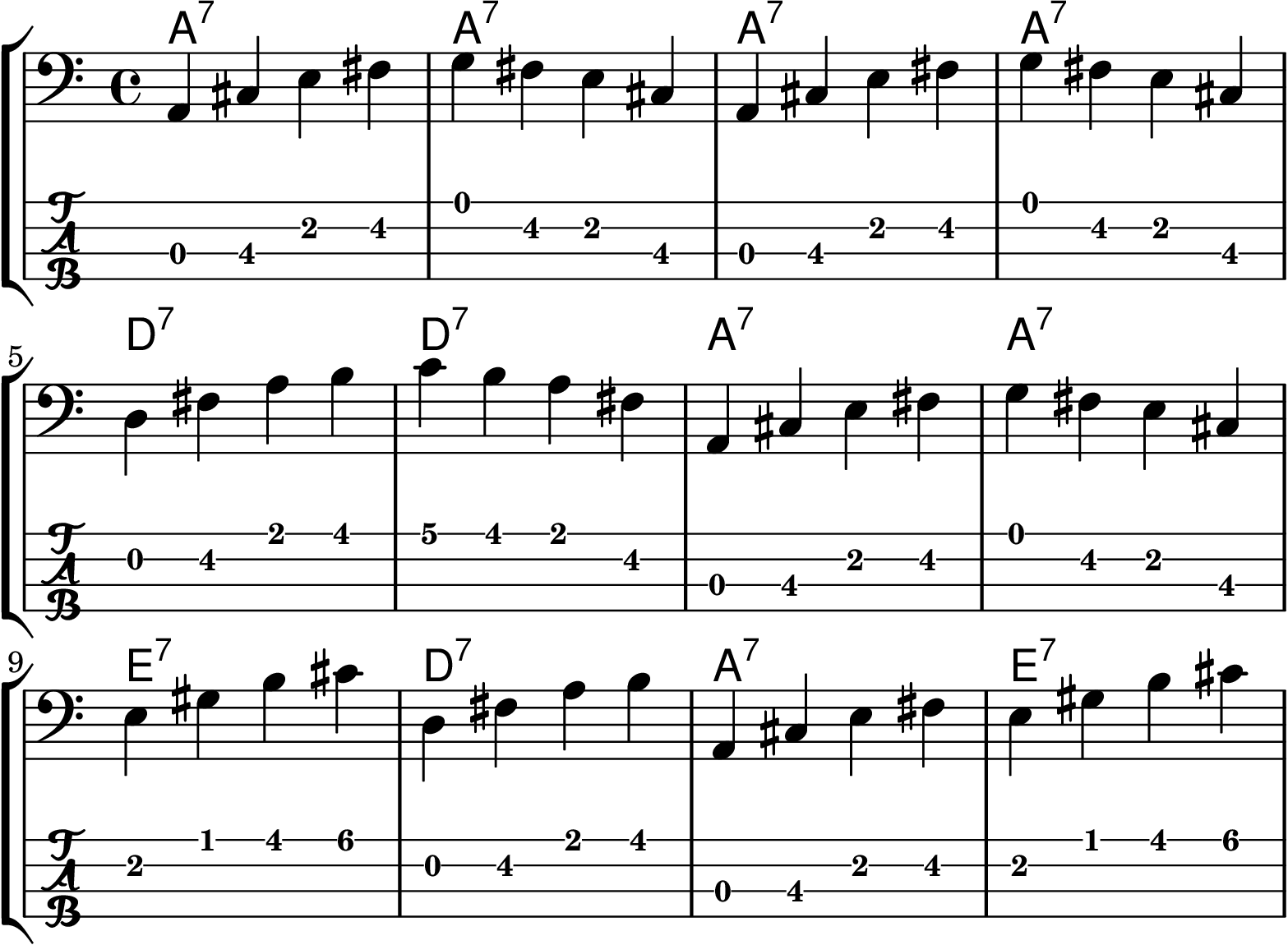
Play it slowly at first, one note per beat, saying the chord names as they change. Once the shape is under your fingers, the whole 12-bar loops on its own.
The Shuffle Groove
Where the walking line moves one note per beat, the shuffle groove sits on the root and “bumps” the beat with the shuffle feel. This is the Chicago and Texas shuffle sound — Jimmy Reed, Duck Dunn, the Blues Brothers band. On each beat you play the root (long) and then the 5th or 6th (short), alternating the top note to keep it moving.
In A: root A with the 5th (E) and 6th (F#) bouncing on top — long-short, long-short — the triplet shuffle driving the whole thing. It’s less busy than the walking line but grooves harder, because every beat reinforces the pocket instead of moving away from it.
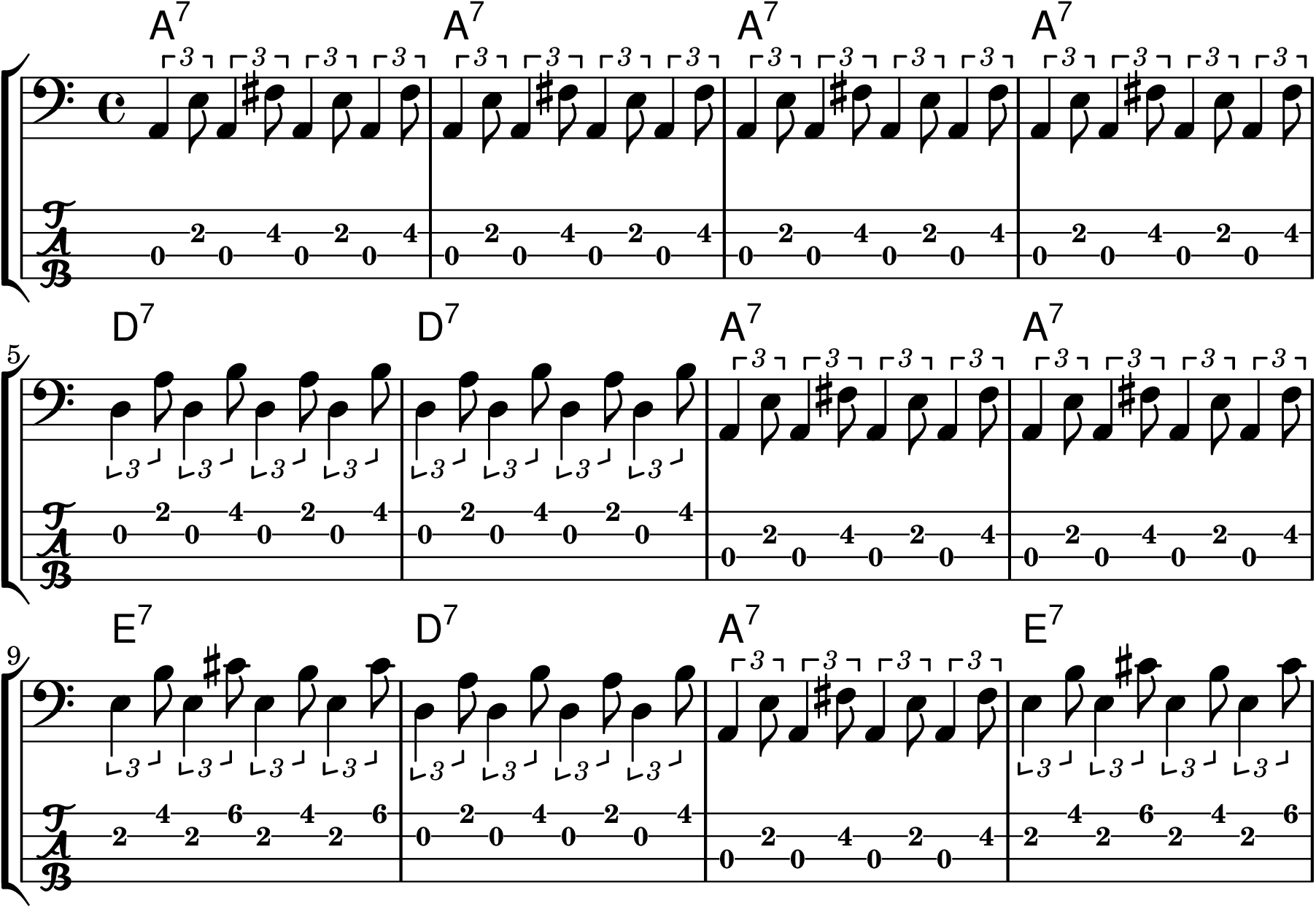
The triplet brackets over each beat show the long-short shuffle exactly. Count “trip-let” on every beat and land the root on “trip,” the fifth or sixth on “let.”
The Turnaround (Bars 11–12)
The turnaround is the last two bars — the moment the progression pulls back to the top. Getting it right is what separates a bassist who knows the 12-bar from one who plays it musically.
The most useful bass turnaround is a chromatic walk down from the root to the V chord: in A, play A – G – F# – F descending, landing on E (the V) to set up the next chorus. It creates tension that resolves the moment the band hits the top again. The exact notes matter less than the direction — the line should feel like it’s dragging the music back around.
Songs to Practice These Over
Patterns only stick when you play them over real music. Put on the recording, find the key, and apply the line:
- “Sweet Home Chicago” — the ultimate starting point. Straight 12-bar in E or A; perfect for the shuffle groove.
- “Pride and Joy” — Stevie Ray Vaughan — the definitive Texas shuffle in E. Great for locking the shuffle feel.
- “Hoochie Coochie Man” — Muddy Waters (Willie Dixon) — a stop-time riff that teaches space. Less is more.
- “Boom Boom” — John Lee Hooker — a driving, root-heavy groove; feel over notes.
- “Johnny B. Goode” — Chuck Berry — the boogie-woogie walking line at speed. Tests your endurance and pocket.
- “The Thrill Is Gone” — B.B. King — a slow minor blues, ideal for practising the walking line with dynamics.
Common Mistakes to Avoid
- Playing straight instead of shuffle. The most common one. The notes are right, but the swing is missing, so it sounds like rock, not blues.
- Rushing. Sitting on top of the beat makes blues sound anxious. Blues pocket sits slightly behind — heavy, not hurried.
- Overplaying. The shuffle groove grooves harder than a busy walking line at most tempos. Don’t fill every space just because you can.
- Ignoring the turnaround. Playing the same pattern through bars 11–12 leaves the progression feeling flat.
- Not listening to the kick drum. Blues bass is a duet with the drummer. If your notes and the kick aren’t aligned, no line will save the groove.
What Makes Blues Bass Feel Right
The notes are learnable in a week. The feel takes longer. Three things separate authentic blues bass from blues bass that sounds like an exercise:
Space. Blues bass breathes. Not every beat needs to be busy. The shuffle groove works because it leaves room — listen to Willie Dixon, who plays less than you expect and grooves enormously.
Dynamics. Dig in on the turnaround, lay back on the verse. Blues is a conversation — the bass responds to the guitarist and vocalist, not just its own pattern.
Pocket. Blues pocket is deep and slightly behind the beat. If your blues feels anxious, you’re on top of the beat — sit back into it. The pocket guide covers how to develop this specifically.
Keep Going
The 32 Grooves Pack includes groove patterns that apply directly to blues contexts — hand-written notation, drum loops, full and slow tempo video. €13.50.
For the complete technique system including groove application in multiple styles, the Ultimate Bass Vault is 8+ hours of structured content. $49.
If you want your blues playing assessed — pocket, note choices, shuffle feel — the Video Review gets you personal feedback within 3 days. €22.50.
→ Walking bass lines — the 4-beat formula, applied here to blues harmony.
→ Bass and drums pocket — blues pocket is deep; here’s how to develop it.
→ Music theory for bass — understanding dominant 7th chords makes these lines make sense.
Frequently Asked Questions
What is the most common blues bass line?
The boogie-woogie walking line: a two-bar pattern that climbs and descends through the chord — root, 3rd, 5th, 6th, then flat 7th, 6th, 5th, 3rd. In A that’s A–C#–E–F# | G–F#–E–C#. It outlines the dominant 7th chord and moves to each new root across the 12-bar form.
What is the shuffle feel in blues bass?
Shuffle feel is triplet-based: each beat is split into a triplet and you play the first and third notes — long, then short — skipping the middle (“trip-let”). It’s the swing that makes blues sound like blues rather than rock, and nearly every blues bass line is played with it.
What’s the difference between the walking line and the shuffle groove?
The walking line moves one note per beat, spelling out the chord (root-3-5-6). The shuffle groove stays on the root and bumps the 5th and 6th on top with the shuffle feel. The walking line is more melodic; the shuffle groove is more driving and leaves more space.
What key is blues bass usually played in?
Most commonly E, A, G, and B on guitar-led sessions; for horn-led blues, F, Bb, and C are common. Learn these lines in A first — the root sits on the open A string, which makes the shapes easy to see and move to other keys.
What are good songs to practice blues bass?
Start with “Sweet Home Chicago” for the basic shuffle, “Pride and Joy” by Stevie Ray Vaughan for the Texas shuffle feel, and “Johnny B. Goode” for the boogie-woogie walking line. For slower, more melodic practice, try “The Thrill Is Gone” by B.B. King.