Bass Guitar Brand Rankings 2026: Which Brands Sell the Most and Why
The global bass guitar market reached $1.8 billion in 2025. Twenty million bass guitars are produced every year. But which brands actually dominate the market — and why do players keep coming back to them?
This article pulls data from DataIntelo, Archive Market Research, NAMM, Gitnux, ShelfTrend, and Future Market Report to give you the most complete picture of bass guitar brand performance in 2026.
Free: Slap Bass Starter Pack
5 video lessons with slow-motion takes, drum loops and tabs. Enter your email and download it right away.
Key Statistics at a Glance
| Metric | Value | Source |
|---|---|---|
| Global bass guitar market size (2025) | $1.8 billion | DataIntelo |
| Projected market size (2034) | $2.9 billion | DataIntelo |
| Annual bass guitars produced globally | 20 million units | Archive Market Research |
| Top 5 brands combined market share | 52% of global revenue | DataIntelo |
| U.S. bass guitar unit sales peak (2022) | 650,000 units | Gitnux |
| Bass guitars as % of total guitar market | 10% | Market Reports World |
| Online sales share (North America) | 47% of sales by value | DataIntelo |
| Amateur players share of revenue | 58.4% | DataIntelo |
The Top 5 Bass Guitar Brands by Market Share
According to DataIntelo’s 2025 Bass Guitar Market Report, five brands collectively account for 52% of global bass guitar revenue: Fender, Gibson, Yamaha, Ibanez, and Warwick. Here is how each brand stands in 2026 and what drives their dominance.
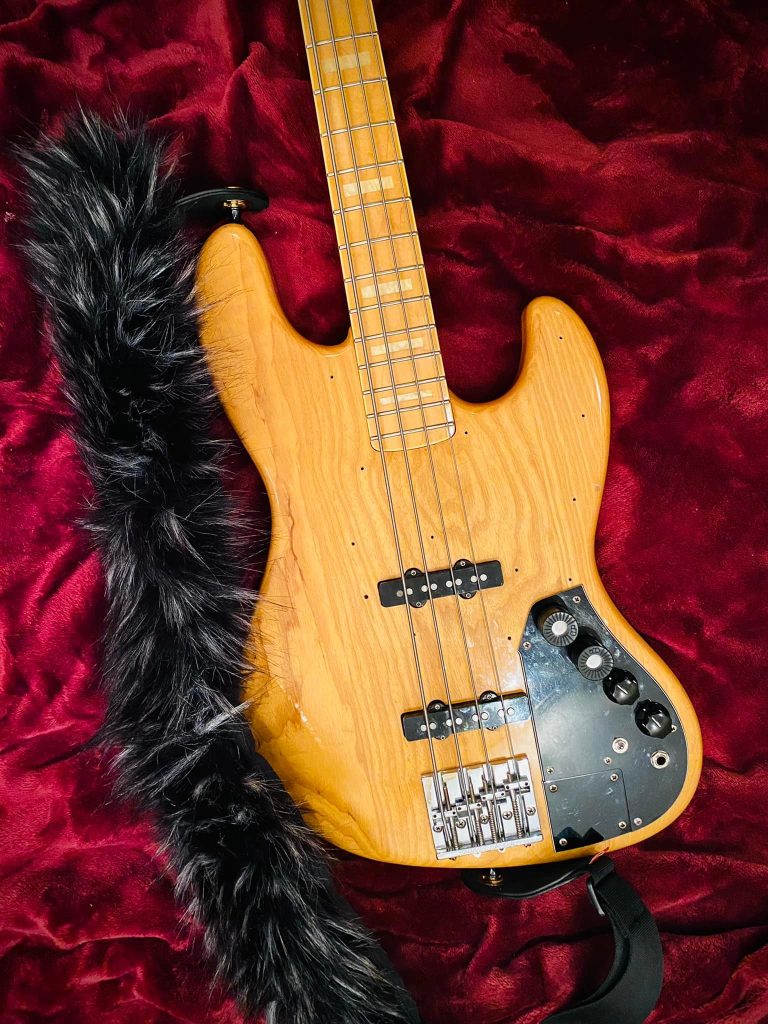
1. Fender — The Market Leader
Fender Musical Instruments Corporation leads the competitive landscape in 2025, according to DataIntelo. Within the broader guitar market, Fender commands approximately 30% of U.S. guitar market share, with Gibson holding 34% in the premium segment (NAMM/ShelfTrend).
Fender’s bass division is built around two models that have defined the instrument since the 1950s: the Precision Bass (P-Bass) and the Jazz Bass (J-Bass). According to DataIntelo’s Fender Market Report, both models dominate the bass guitar segment among professional bassists across virtually every genre.
Fender Bass Market Data:
| Metric | Value | Source |
|---|---|---|
| U.S. guitar market share (all products) | 30% | NAMM/ShelfTrend |
| Fender electric guitars sold globally (2023) | 450,000 units | Market Reports World |
| Fender sales under $500 growth (2020) | +92% | Gitnux |
| Fender Play free trial registrations (2020) | 930,000 in 3 months | Fender |
| Squier entry-level instruments sold (2022) | 250,000 units | DataIntelo |
Fender’s strength lies in vertical market coverage. The company controls the entry-level market through Squier, the mid-range through the Player and Professional series, and the premium market through the American Ultra and Custom Shop lines. This means a player who starts on a $300 Squier Affinity Jazz Bass may spend their entire career buying Fender instruments as they upgrade.
Squier alone sold 250,000 entry-level instruments in 2022, making it the dominant force in the beginner bass segment. The Squier Affinity and Classic Vibe series are consistently the best-selling bass guitars in the $200–$500 range.
In March 2025, Fender announced a strategic partnership with a major online retailer to create exclusive Fender and Squier bass bundles, targeting direct-to-consumer sales for entry-level and mid-tier models (WiseGuy Reports, 2025).
2. Yamaha — The Consistent Performer
Yamaha Corporation is the fourth-largest player globally by market share, selling approximately 1.2 million guitars across all types in 2022 (Gitnux). In the bass segment specifically, Yamaha’s BB series and TRBX series are among the most recommended instruments at every price point from $200 to $1,500.
Yamaha Bass Market Data:
| Metric | Value | Source |
|---|---|---|
| Total Yamaha guitar sales globally (2022) | 1.2 million units | Gitnux |
| Global guitar market share | ~7% | ShelfTrend |
| BB series price range | $200–$1,500 | Manufacturer |
| TRBX series price range | $200–$600 | Manufacturer |
Yamaha’s competitive advantage in the bass market is build quality consistency across price tiers. The BB234 at $300 and the BB735A at $700 share the same core design philosophy — passive electronics, Alnico V pickups, and a neck construction that has been refined since the original BB series launched in 1977.
Japan’s unique position in the global bass market gives Yamaha structural advantages. As DataIntelo notes, Japan is simultaneously a top consumer market and the home of globally significant manufacturers, with Yamaha, Ibanez (Hoshino Gakki), and ESP all headquartered there. This gives Japanese brands outsized influence on both production standards and innovation.
Yamaha’s endorsers historically include Nathan East, one of the most recorded session bassists in history, whose warm, clear tone on thousands of major recordings represents the BB series character at its highest level.
3. Ibanez — The Modern Player’s Choice
Ibanez, manufactured by Hoshino Gakki Co., Ltd., is the third-largest global bass brand and the dominant force in the modern, active, and extended-range bass segment. In Asia-Pacific markets, Ibanez sold approximately 300,000 units in 2023 (Gitnux).
Ibanez Bass Market Data:
| Metric | Value | Source |
|---|---|---|
| Asia-Pacific unit sales (2023) | 300,000 units | Gitnux |
| Global guitar market share | ~12% | ShelfTrend |
| SR series price range | $300–$2,000 | Manufacturer |
| EHB headless series launch | 2020 | Manufacturer |
Ibanez’s strength in the bass market comes from targeting players who want modern features — active electronics, lightweight bodies, fast slim necks, and multi-scale construction — at accessible prices. The SR (Soundgear) series is one of the best-selling bass lines in the $300–$800 range globally.
In June 2025, Ibanez launched a flagship multi-scale six-string and four-string bass line under the premium Soundgear family, incorporating new pickup configurations and lightweight carbon fiber composites (WiseGuy Reports, 2025). This signals continued investment in the advanced player segment.
The SRMD200 brought multi-scale (fanned fret) construction to the budget market, making a format previously available only in boutique instruments accessible at under $400. This pattern — boutique innovation at accessible prices — defines Ibanez’s product strategy.
4. Ernie Ball Music Man — The Professional Standard
Ernie Ball Music Man occupies a specific and influential position in the bass market: the premium production bass that professional players actually use on stage and in studios. The StingRay, introduced in 1976, was the first mass-production bass with an active onboard preamp — a genuine revolution at the time.
Music Man Bass Market Data:
| Metric | Value | Source |
|---|---|---|
| StingRay original launch | 1976 | Manufacturer |
| First production bass with active preamp | Yes | Industry record |
| StingRay price range (new) | $1,500–$2,000 | Manufacturer |
| Vintage StingRay market value (1987) | $1,500–$2,500 | Reverb.com |
| Sterling by Music Man (budget line) | $300–$600 | Manufacturer |
Music Man does not publish unit sales figures, but their market position is reflected in their influence. The StingRay appears on more professional recordings in funk, R&B, and pop than virtually any other bass. Players including Flea (Red Hot Chili Peppers), Louis Johnson, and Tony Levin built their signature sounds on Music Man instruments.
The Sterling by Music Man sub-brand extends the StingRay design to the $300–$600 price range, significantly expanding the brand’s addressable market while maintaining the core pickup and electronics architecture.
5. Warwick — The European Premium Leader
Warwick GmbH and Co. Music Equipment KG is identified by DataIntelo as one of the top five global bass brands by revenue, representing the premium and boutique segment from a European manufacturing perspective. Warwick instruments are built in Markneukirchen, Germany, and are known for exotic tonewoods, high-quality MEC electronics, and a distinctive tonal character.
Warwick Bass Market Data:
| Metric | Value | Source |
|---|---|---|
| Manufacturing location | Markneukirchen, Germany | Manufacturer |
| Pro Series price range | $800–$2,000 | Manufacturer |
| German Custom Shop price range | $2,000–$5,000+ | Manufacturer |
| RockBass (entry line) price range | $400–$700 | Manufacturer |
| Top 5 brands combined revenue share | 52% | DataIntelo |
Warwick’s market position is built on the professional and serious amateur segment. Their instruments are consistently cited in professional bass circles for the “Warwick growl” — a distinctive low-mid tonal character produced by dense tonewoods including bubinga, wenge, and ovangkol.
The RockBass line, manufactured in Asia to Warwick’s specifications, extends the brand’s reach to the $400–$700 price range and represents the company’s direct response to the mid-range competition from Yamaha and Ibanez.
Brand Performance by Price Segment
Understanding which brands dominate at each price tier is essential for buyers and for understanding the competitive landscape.
| Price Tier | Dominant Brands | Market Role |
|---|---|---|
| Entry level ($100–$300) | Squier, Ibanez GSR, Yamaha TRBX204 | Highest unit volume |
| Budget mid-range ($300–$500) | Yamaha BB series, Ibanez SR, Cort | Most contested segment |
| Mid-range ($500–$800) | Yamaha BB700 series, Ibanez SR Premium, Warwick RockBass | Strong player upgrades |
| Professional ($800–$2,000) | Fender American, Music Man, Warwick Pro Series | Solid revenue share |
| Premium ($2,000+) | Sadowsky, Music Man Custom, Warwick Custom Shop | High revenue, low volume |
| Boutique ($3,000+) | Fodera, Sadowsky NYC, Lakland, Zon | Niche but growing |
According to DataIntelo, the $100–$500 bracket is the most commercially significant for bass guitars, representing the highest unit volume and the primary entry point for new players. Squier, Ibanez GSR, Yamaha TRBX, and Cort Action dominate this segment.
The Challenger Brands Worth Watching
Beyond the top 5, several brands are gaining meaningful market share.
Cort has quietly become one of the most respected mid-range manufacturers. Cort builds instruments under contract for major brands, which means their quality standards are higher than their price points suggest. The Cort Action series ($200–$400) and Artisan series ($600–$900) are consistently rated above their price class.
Fujigen (FGN) manufactures in Matsumoto, Japan, and produces instruments under contract for Fender Japan and Ibanez. Their own-brand FGN instruments represent genuine Japanese craftsmanship at prices well below equivalent Fender American products.
Sadowsky occupies the upper-premium segment with NYC Custom Shop instruments ($3,200–$4,500) and the MetroLine made in Germany ($1,500–$1,800). The Sadowsky preamp design has been influential enough that the company sells it as a standalone outboard unit.
Harley Benton (Thomann’s house brand) is identified by ShelfTrend as a rising innovator gaining significant market share in the European budget segment, offering exceptional value at $100–$400 price points.
Online vs. Offline Sales by Brand
The shift to online retail has affected different brands differently. According to DataIntelo, online channels represent 47% of North American bass guitar sales by value in 2025, up from approximately 20% pre-pandemic.
| Channel | Share of Sales | Trend |
|---|---|---|
| Online (North America) | 47% by value | Growing — CAGR ~7.4% |
| Offline retail | ~53% by value | Stable but declining |
| Online globally (all guitars) | 38% of U.S. purchases (2023) | Up from ~20% pre-pandemic |
| Used/vintage market | $2.1 billion projected (2025) | Growing 5.5% annually |
Brands with strong direct-to-consumer platforms — primarily Fender (through Fender.com and Fender Play) and Music Man — benefit disproportionately from the online shift. Boutique brands like Sadowsky and Fodera have also benefited from global online reach that physical retail never provided.
The used market is increasingly significant. Reverb.com sold $130 million in guitars in 2019, and the broader used instrument market has expanded substantially. For bass players, the used market at $300–$800 offers dramatically better value than new instruments in the same price range — particularly for vintage Fender, early Ernie Ball Music Man, and Japanese-made instruments from the 1980s.
Regional Brand Dominance
Brand performance varies significantly by geography.
| Region | Market Share | Dominant Brands | Notes |
|---|---|---|---|
| North America | ~28% of global market | Fender, Music Man, Gibson | Premium-focused buyers |
| Europe | ~27.3% of global market | Warwick, Fender, Yamaha | Strong bass culture, UK/Germany lead |
| Asia-Pacific | ~45% of global market | Ibanez, Yamaha, ESP | Fastest growing region |
| Latin America | ~5.4% | Fender, Ibanez | Brazil and Mexico lead |
Asia-Pacific represents 45% of global guitar market share and is the fastest-growing region (Market Reports World, 2026). Japan’s Yamaha and Ibanez are positioned to benefit from continued growth in China, South Korea, and Southeast Asian markets.
South Korea’s K-pop ecosystem is creating new professional bass demand. DataIntelo notes that K-pop and K-indie bass players are a growing segment, stimulating demand for mid-range and professional instruments — a trend that particularly benefits Ibanez and Yamaha given their strong brand recognition in Korean music culture.
What the Data Tells Us About Choosing a Brand
The sales data reveals patterns that matter for players making purchasing decisions.
Fender dominates because of ecosystem. The Squier-to-American pipeline means players who start with Fender tend to stay with Fender. The brand recognition also matters for resale value — a used Fender American holds its value better than comparably built instruments from less recognized brands.
Yamaha wins on value consistency. At every price point from $200 to $1,500, Yamaha delivers build quality that consistently exceeds price expectations. The BB series in particular offers passive tone quality that competes with instruments at double the price.
Ibanez owns the modern player market. Players who want active electronics, fast necks, and modern features at accessible prices consistently land on Ibanez. The SR series represents the best value in active bass at the $400–$800 range.
Music Man earns its premium. The StingRay’s active preamp, distinctive single humbucker, and 50-year track record justify its price premium for players who specifically need that character. No other production bass sounds quite like a StingRay.
Warwick justifies German pricing. The construction quality, exotic tonewoods, and MEC electronics in Warwick Pro Series instruments represent genuine value at their price points — particularly compared to boutique alternatives at higher prices.
Frequently Asked Questions
Which bass guitar brand sells the most? Fender is the leading brand in the bass guitar market globally, with Fender Musical Instruments Corporation identified as the top player in DataIntelo’s 2025 Bass Guitar Market Report. Within the broader guitar market, Fender holds approximately 30% of U.S. market share.
What are the top 5 bass guitar brands? According to DataIntelo’s 2025 research, the top five brands by global market revenue are Fender, Gibson, Yamaha, Ibanez, and Warwick. These five collectively account for 52% of global bass guitar market revenue.
Which bass guitar brand is best for beginners? Squier (Fender’s entry-level line) sold 250,000 entry-level instruments in 2022 and remains the dominant force in the beginner bass segment. The Squier Affinity Jazz Bass and Yamaha BB234 are the most consistently recommended entry-level bass guitars by music educators and experienced players.
Which bass guitar brand do professional players use most? Professional players represent approximately 20% of unit sales but 41.6% of market revenue (DataIntelo), meaning they spend significantly more per instrument. Fender American series, Ernie Ball Music Man, Warwick German Custom Shop, and boutique brands like Sadowsky and Fodera dominate the professional segment.
Is Ibanez or Yamaha better for bass? Both are excellent brands serving different needs. Ibanez excels at modern, active, fast-playing basses in the SR series. Yamaha excels at traditional, passive instruments with exceptional build quality in the BB series. The choice depends on playing style — modern and active vs. classic and passive.
What is the fastest-growing segment in bass guitars? The 5-string bass format is the fastest-growing product type within bass guitars, driven by modern music styles requiring extended low-end range (DataIntelo, 2025). Metal, progressive rock, and modern pop production are the primary drivers.
Sources
- DataIntelo: Bass Guitar Market Report 2025
- DataIntelo: Fender Market Research Report 2034
- Archive Market Research: Bass Guitars Report 2026
- Market Reports World: Guitar Market Report 2026
- Gitnux: Guitar Sales Statistics 2025
- ShelfTrend: Guitar Market Analysis 2025
- WiseGuy Reports: Bass Guitar Market Trends 2026
- Future Market Report: Bass Guitars Market Size 2025–2032
- NAMM: Global Music Report
- Fender Musical Instruments Corporation: Public statements 2020–2025
- Reverb.com: Market data 2019–2023
Last updated: May 2026
Whatever Brand You Play, Technique Wins
The bass matters far less than what you can do with it. Start with the free pack and go from there.