Can You Slap a Rickenbacker 4001 Bass? I Tested It So You Don’t Have To
Someone in the comments of one of my videos asked me if you can actually slap a Rickenbacker. I laughed. Then I thought about it for a second. Then I went and got one.
The honest answer is: yes, you can slap a Rickenbacker 4001. Whether you should is a different conversation.
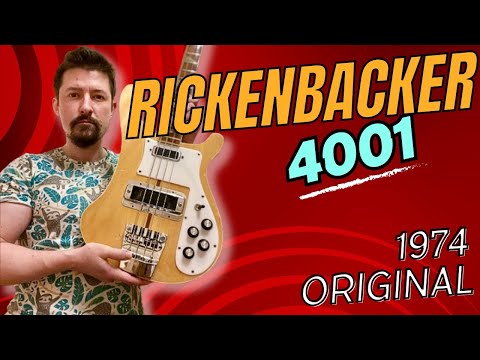
Rating: 5/5
Verdict: The Rickenbacker 4001 can be slapped: the thumb finds a good contact point, and the bright, midrange-forward passive pickups give slap a crunchy, upper-mid character unlike other basses. The geometry demands changes to your technique, and the bridge-pickup capacitor thins the low end. It is extraordinary for aggressive rock lines, chord-style playing and the signature Rickenbacker sound. It is not a primary slap bass and not ideal for beginners.
| Spec | Rickenbacker 4001 |
|---|---|
| Scale | 33.5″ (long scale), 20 frets |
| Body | Solid maple, bound |
| Neck / fretboard | Maple neck-through-body, dual truss rods; bound fretboard with triangle inlays |
| Pickups | Two passive single coils: Hi-Gain at both positions from 1973 (toaster/horseshoe earlier) |
| Electronics | Passive; capacitor in the treble pickup circuit on basses built before 1984 |
| Outputs | Mono jack plus Rick-O-Sound stereo output (from 1968) |
| Production | 1961–1986; succeeded by the 4003 |
| Best for | aggressive rock bass lines, chord-style playing and the signature Rickenbacker sound; slap as an experiment in adapting technique |
| Not for | a primary slap bass; beginners (better as a second or third instrument) |
Free: Slap Bass Starter Pack
5 video lessons with slow-motion takes, drum loops and tabs. Enter your email and download it right away.
The Rickenbacker 4001 — What You’re Dealing With
The Rickenbacker 4001 is not a typical bass. It was built during the 1960s–1980s and it has a sound that is completely its own. Chris Squire of Yes used it to build one of the most distinctive bass tones in rock history. Lemmy of Motörhead pushed it through a wall of Marshall stacks and made it sound like an earthquake. Paul McCartney played one on some of the most famous recordings ever made.
The neck on the 4001 is bound and has a distinct feel — thicker than a Jazz Bass, with a different string-to-body geometry. The pickups are passive single coils — on a 1970s 4001, two Rickenbacker Hi-Gain units — and they produce a sound that is inherently bright and midrange-forward. Not the usual recipe for slap bass.
Trying Slap on This Instrument
The first thing you notice when you try slapping on the 4001 is that the string height and the geometry of the bass requires adjustment in your technique. The strings sit differently than they do on a bass designed for slap. The body shape means your thumb hits the string at a slightly different angle.
It works. The thumb gets a good contact point on the lower strings. The pop — pulling the string away from the neck for the percussive snap — feels slightly different because the nut width and string spacing are not the same as a Jazz or Music Man. But you can get a usable slap sound out of it.
What surprised me was how the tone responded. The Rickenbacker pickups, which are voiced for that classic bright-and-mid sound, give the slap tone a character I haven’t heard from other instruments. It’s almost crunchy — a little aggressive, less round than a Stingray slap tone, more pronounced in the upper mids. It’s not a conventional slap tone but it is interesting.
The Limitations
The 4001 has a stereo output — two outputs, one per pickup, originally designed to be split and processed separately. Rickenbacker basses built before 1984 also have a capacitor in the treble (bridge) pickup circuit, which emphasizes the treble from that pickup at the cost of some low end and volume. This means the bridge pickup can sound thin, whichever output you use.
For slap, this is significant. Slap bass needs a full low end to sound right. If you’re getting the capacitor-filtered signal, the bottom drops out and the thumb attack loses the thump that makes slap sound good. You can take the capacitor out of the circuit — Rickenbacker itself dropped it after 1984, and the modern 4003 can switch it in or out — but it’s a consideration.
The other limitation is practical: the Rickenbacker 4001 is a collector’s instrument. Originals in good condition cost $2,500–$5,000+. Using one as your primary slap bass makes no economic sense.
Should You Do It?
As an experiment — absolutely. Playing slap on a Rickenbacker teaches you something about adapting technique to an instrument that wasn’t designed for it. It forces you to be more intentional about your thumb angle and your right-hand positioning.
As a primary slap instrument — no. Get a Music Man Stingray, a Lakland 44-94, or a used Japanese Jazz Bass for slap. The Rickenbacker is extraordinary for what it was designed for: aggressive rock bass lines, chord-style playing, that signature “rick” sound that no other bass replicates. Let it do what it’s best at.
Frequently Asked Questions
Is the Rickenbacker 4001 good for beginners?
Not ideal. The Rickenbacker 4001 has quirks — the stereo output, the bound neck, the specific playing feel — that are easier to navigate if you already have solid fundamentals. It’s better as a second or third instrument once you know what you’re doing.
How much does a Rickenbacker 4001 cost?
Vintage 4001 models from the 1960s–1970s typically sell for $2,500–$6,000 depending on condition and year. The current model is the Rickenbacker 4003, with a 2026 US list price of $2,599 ($2,299 for the unbound 4003S). Used 4003s in good condition are around $1,200–$1,600.
What is the difference between the Rickenbacker 4001 and 4003?
The 4003 is the current production model, introduced in 1979, and replaced the 4001 in 1986. The main differences are an updated truss rod system built for the higher tension of roundwound strings and, on modern 4003s, a Vintage Tone Selector: pull up the treble tone control and the old 4001 capacitor circuit is switched back in. The 4003 is generally considered more practical for modern players.
Which famous bassists used the Rickenbacker 4001?
Chris Squire (Yes), Lemmy Kilmister (Motörhead), Paul McCartney (The Beatles — most notably on Sgt. Pepper and Abbey Road), Geddy Lee (early Rush), Peter Cetera (Chicago). The 4001 has an incredibly distinguished history in rock music.
Related Posts
The 1974 Rickenbacker 4001 is a specific object with a specific history — there’s nothing else in bass guitar history that sounds quite like it. The stereo output capability, the original double truss rod system, the solid maple neck-through construction all combine into a tone that has been imitated but never perfectly replicated.
Testing slap on a Rickenbacker specifically addresses a question that comes up constantly: can you slap on a Rick? The construction makes it harder than on a Jazz or Stingray — the neck and string spacing feel different, the action typically runs a little higher. But the sound when you get it right is absolutely its own thing.
The 70s Rickenbacker tone on slap has a rawness to it that modern instruments lack. More percussive attack, less sustain, a slight bite at the top that no EQ can fully recreate. For players interested in the complete picture of slap bass history, spending time with a vintage Rick is worthwhile.
Want to Level Up Your Bass Playing?
I’ve put together courses and resources that cover everything from slap fundamentals to advanced groove techniques.